
DANCE WORKS
01
RED ROOM
Dance work/ Movement- Based Performance
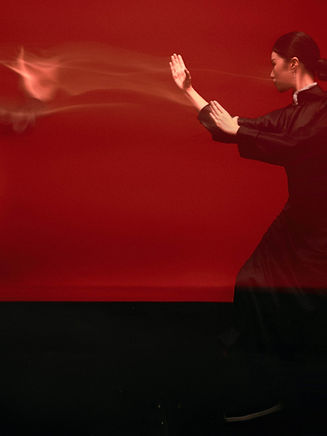
Red Room places the body inside an imagined interior of memory, desire and restraint. The work uses the colour red as both a visual field and an emotional pressure: a space that appears intimate, but never fully safe.
Across the piece, performers move through shifting states of control, exposure and withdrawal. The choreography builds from repeated gestures, interrupted pathways and moments of suspended stillness, allowing the body to reveal what remains hidden beneath the surface of composure.
Rather than treating red as decoration, Red Room approaches it as a dramatic condition. It becomes a room of the mind, a trace of conflict, and a force that stains the relationship between body, space and emotion.
02
STILL TRACE
Dance work/ Movement- Based Performance
Still Trace examines what remains in the body after movement has passed. The work begins from a quiet stage condition, where stillness is not absence, but a charged state filled with memory, delay and withheld emotion.
Across the piece, performers move through restrained gestures, suspended pauses and subtle shifts of weight. A hand almost moves. A breath is held. A body turns away before fully revealing itself. These small physical events become traces of something larger: a memory, a refusal, a loss, or an emotion that cannot be directly spoken.
The choreography focuses on the relationship between motion and residue. Rather than building towards spectacle, Still Trace invites the audience to notice what is left behind by the body — pressure, silence, atmosphere and the fragile evidence of an inner life.


TENGWANG PAVILION PREFACE
Chinese Classical Dance
Tengwang Pavilion Preface is a Chinese classical dance inspired by the literary imagery and cultural spirit of Wang Bo’s renowned prose poem. Drawing from the grandeur of the Tang dynasty, the work transforms the text’s landscapes, atmosphere and emotional resonance into a choreographic language shaped by classical Chinese dance.
The choreography uses group formations to evoke the vastness of river, sky and pavilion. Flowing sleeves, shifting pathways and layered spatial patterns create a moving image of elegance and momentum, echoing the famous sense of openness and poetic imagination within the original text.
Rather than illustrating the poem line by line, the work approaches Tengwang Pavilion Preface as a cultural and emotional landscape. Through refined gesture, breath, gaze and the dynamic rhythm of ensemble movement, the dance presents a world where literature, architecture, nature and the body meet.

Dance Film
Directed and choreographed by Harper WANG, the dance film Mo was presented in the dance-film programme at Guangdong Modern Dance Week. Following a solitary performer through an imagined desert, the work explores isolation, instability and endurance through movement, sound, light and cinematic composition. Its title suggests desert, silence, remoteness and emotional distance.
The choreography develops through contraction, suspension, imbalance, collapse and recovery. The dancer repeatedly reaches outward before folding back into the body, while recurring gestures gradually shift in quality. Empty space and off-centre framing strengthen the sense of isolation and give each movement greater dramatic weight.
Camera, editing, light and shadow extend the choreography beyond the performer’s body. Wide shots emphasise the dancer’s vulnerability within the landscape, while close framing reveals breath and physical tension. The shadow becomes an unstable extension of the body, suggesting fear, memory and internal conflict. Mo demonstrates WANG’s strong control of screen choreography, atmosphere and physical storytelling.